
.jpg)
Lalia was ready to turn her new tailoring skills into a livelihood and a fresh start in life. Then, the opportunity disappeared overnight, taking with it the hope of stability for her family and countless others.
Lalia, 25, was among those caught in the fallout. The young mother of two was set to begin the second and final phase of her tailoring training in Congo when the funding cuts came. The program’s sudden closure ended her plans just days before she was scheduled to return. She had been part of the KCCA funded program for teenagers and young adults from underserved areas in eastern Congo. The one-year, initiative KCCA Tailoring Program focused on women and girl mobilization, entrepreneurship, and vocational training. The program intended to equip more than 200 women and girls in Uvira, DR Congo with practical skills and job certification to enter the workforce. For participants like Lalia, it offered a rare path out of poverty. Lalia background echoes that of many who joined the program: she became pregnant in her teens, left school after primary education, and struggled to feed her family. Her job at a local supermarket barely covered the cost of her commute to work. “There were days when I ate only once,” she recalled. “Sometimes I went days without food.”
Lalia profits from the free tailoring course
offered by KCCA
A Dream Become a Reality
When she learned about KCCAs Tailoring Program last year, Lalia hesitated. The commute was long, and she and her family were unsure it would be worth the sacrifice. But she took the leap. After her mother agreed to help care for her children, she enrolled. “At first, I was scared how others would see me,” she said of her insecurities before beginning the training. “But after I shared my story, my struggles as a young mom, my classmates were so kind and warm with me.”
Her confidence grew as she mastered a particularly challenging dress design early in the program. “My classmates were impressed,” she said. “And when I brought the dress home, my family was so proud!” After completing the first phase, she succeeded to get the tailoring machine from KCCA after finishing the tailoring course.

Lalia profits from the free tailoring course offered by KCCA

Lalia received her tailoring machine from KCCA.
Lalia benefitted to get the tailoring machine from KCCA after succeeding the tailoring course.
Dignified Work
Women want to earn income as equals, but they face many barriers in the workplace and at home. These can be issues they face in the workplace, like unequal working conditions, and challenges in other spaces, including their homes, their communities, and during their commute. The challenges impact women’s ability to stay in work, the conditions of their work, and whether they benefit from the money they earn. From domestic workers to those employed in the garment industry, KCCA fights to ensure women can access dignified employment opportunities.
Lalia thanks KCCA for transforming her life, bringing her from poverty. She benefitted from the tailoring course and is able to improve her life economically. Lalia is able now to start her own business and earn income to support her family. because of KCCAs Tailoring Program Lalia is able to change her life.

Lalia starts her own business

Lalia now is able to manage her own business of tailoring
Back To School Supplies for Children
Classrooms are full in South-Kivu, DR Congo. In Uvira City, there are 75 students in one small room, four children to a bench. Half of the school’s 750 students attend in the morning, the other half in the afternoon.
“It is not easy, but at least they have a school to go to,” one of the teachers reflected. There are classes up to the seventh grade here, and the student ages range. Some children repeat grades because there is no higher-level school, while other students have been out of school for several years. The ongoing conflict in Uvira has forced hundreds of thousands of people from their homes, leaving many families in a desperate search for food, shelter, and safety. Yet, regardless of their background or age, these students come together to sing, learn, and study.

Maria in the classroom in Uvira, DRC.
Addressing menstrual and other hygiene needs in schools
The school’s latrines also lack access to water, which makes hygiene a big challenge for the school and the students. “Especially for the girls on their period, not having access to water is a problem,” says the director. There is not enough water in the school to wash the cloths they use for menstrual hygiene. “I use a plastic bag and take it home to wash it there,” explains Maria. Buying soap to wash the cloth is another challenge for her.
Maria is part of a girl's group at school that learns about menstrual hygiene from a KCCA volunteer. She has also received a menstrual hygiene kit, which includes underwear, three washable cloths pads, and a cycle tracker.
High hopes in a land of scarcity
Maria is 12 and in the seventh grade. She is not sure if she will be able to continue her education after finishing this grade, as the nearest school offering higher levels is too far away, and her family cannot afford to send her. But Maria has high hopes. “I want to be a doctor to help other people,” she says. Her 14-year-old brother is in the same class, because he can’t attend a higher-level school. Maria and her brother’s school time is in the afternoon, from 12:30 to 5:30. In the morning, they help their parents in the fields. “I cut grass, so my parents can plant the seeds, and I help with harvesting,” she says.
_edited_edited_jp.jpg)
Maria getting support from KCCA Coordinator for hygiene.
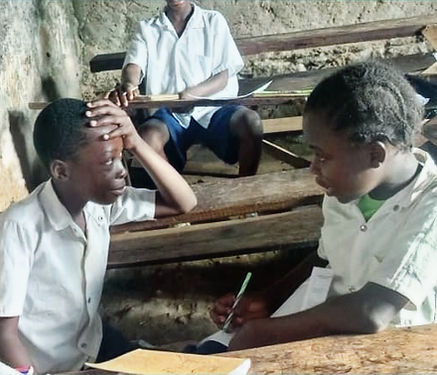
Maria discussing with her brother during class.
What KCCA is Doing
That belief in human resilience and in the power of standing with people through the darkest moments was the foundation of KCCAs mission. The first shipment of KCCA PACKAGE parcels carried more than food; schools supplies, and school fees were also distributed. They carried dignity, and comfort, a charitable reminder at the aftermath of war.
For supporting the orphans KCCA as a program each year distributes school supplies and gives school fees for the kids to give them hope for tomorrow.

Maria receives the school supplies for her journey of hope for tomorrow.
KCCA set new standard for tracking and measuring women’s digital inclusion
The new digital framework developed by KCCA aims to help people understand not just access, but agency, the tool will strengthen the way digital inclusion programs are planned and delivered, support women’s choices, and shape policies that move beyond connectivity toward meaningful inclusion. The effort is part of KCCAs Digital Impact Hub, which expands the benefits of technology to people living in poverty and crisis to ensure that digital tools advance opportunity rather than deepen inequalities. KCCA, an international nonprofit that partners with women living in extreme poverty to build economic opportunity and inclusion, is leading the initiative. KCCA is bringing the concept of digital agency to life through clear, practical indicators that reflect women’s real experiences.
The model takes a step-by-step view of digital empowerment: beginning with access and connectivity; then progressing to digital skills, confidence, control; and ultimately the ability to use technology to improve lives and livelihoods.
KCCA empower and encourage the women and girls for promoting them for free training of technology improving their digital skills. 25 girls benefitted in 2025.

Koleta and Marta benefitted for the KCCA Digital Impact Hub.

Koleta and Marta sharing ideas during the digital training.